debian 13 upgrade | octopode
01 Sep 2026 - harry
I took the bank holiday weekend as an opportunity to do a task I’d been putting off for a while - upgrading my homelab vms from debian 12 to debian 13 :aaaaaa: , this is because debian 12 is now out of regular security support (and has been for over a month (oops)).
I was pretty worried this could snowball into a task that would take all three days to resolve if I ended up breaking something. The official upgrade guide is really long, but I had a better idea.
In theory, as I’ve got everything set up as IaaC with ansible and open tofu (terraform fork), along with automatic backup and restore of my container data to/from my nas, all I needed to do was change the vm os image resource in my tf config to point at debian 13 (rather than 12), then run tofu apply, and run my playbooks with ansible-playbook , the vms should be recreated and then ansible should deploy all my services, pulling backups from the nas as appropriate.
So I did it and waited nervously for 20 mins as everything was re-provisioned, and …, it worked*****!
Well almost worked, everything but nextcloud and jellyfin came back exactly as they were. Nextcloud didn’t work because I wasn’t actually correctly backing up its data (something I learned after fighting with it, for 2 hours), and jellyfin didn’t work because the intel decoding driver system package is no longer included in debian 13 (but I can install it manually from intel’s github). I think this was also a pretty good test of my disaster recovery process since this was essentially the same - but I still need to test my offsite backups.
Some lessons learned:
- Upgrading vms in a rolling manner starting from the lowest risk to the highest risk worked well and helped me build confidence in the process.
- I didn’t delete the old vms until I had verified the new ones were working (saved me when I nearly lost the nextcloud data)
- Adding notes with all the snags I found (surprisingly few) and updating my playbooks to prevent them in future (mostly just the docker group id changing between OS installs), and the notes that I had in my repo from previous tasks like this were invaluable.
- Avoid scope creep!! This was meant to be just an OS upgrade but also turned into a refactor of my .tf file, but I managed to stop it there. If I’d let this become the refactor of my playbooks into roles (that I’m definitely for sure going to do one day soon…) that I was also tempted to do it would have taken the entire weekend, and been a lot riskier.
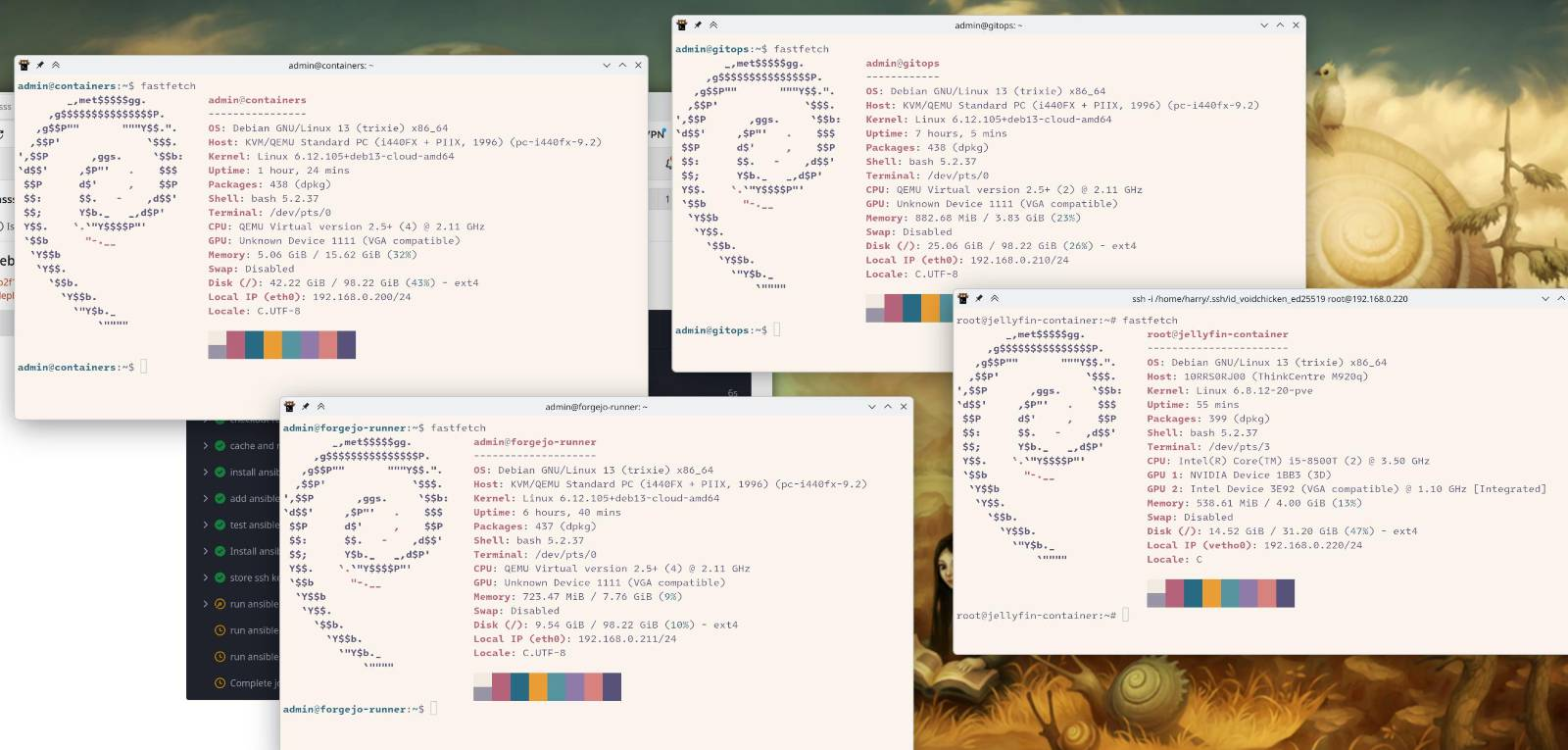
obligatory fastfetch